
Franklin County Sex Offender Checks
The Iowa Sex Offender Registry is the primary public channel for Franklin County. The Iowa Department of Public Safety Division of Criminal Investigation maintains it. Search by a person’s name, ZIP code, city, county, or address rather than relying on an unofficial list. Name searching works best when spelling and aliases are considered. A place search is more useful for broad community awareness because it does not assume that a searcher already knows a name.
The public website is not the complete registry. Iowa Code limits which records and fields appear. The Franklin County Sheriff can provide additional information allowed by law and handles local registration at the Law Enforcement Center. For someone who may have moved across state lines, the National Sex Offender Public Website adds participating jurisdictions. Each channel answers a different part of the question, so an Iowa result should not be treated as a nationwide finding.
Franklin County Registration Office
People registering outside an Iowa correctional facility report through county sheriff offices. In Franklin County, that office is the Law Enforcement Center at 105 5th Street SW in Hampton. Administrative hours are 8:00 a.m. to 4:00 p.m. on weekdays, and the office number is 641-456-6035. A person changing residence must report in person within five business days. Calling first is wise because the official county material does not publish a special appointment calendar or document checklist.
The sheriff sends registration data to DCI’s central file. Iowa DOC completes registration before release from a correctional facility, which means the route depends on custody status. The Franklin County Sheriff page confirms the local office and contact details. This local role is important when a Franklin County profile appears incomplete or a recent move has not yet been reflected in a public search.
Franklin County Sheriff
Law Enforcement Center
105 5th Street SW
Hampton, IA 50441
641-456-6035
Monday-Friday, 8:00 a.m.-4:00 p.m.
Iowa Sex Offender Registry Searches
The official registry offers basic, advanced, map, telephone, and email modes. Start with only the facts that are known. A broad county search can show Franklin County entries, while an address or ZIP search focuses on a smaller area. Accept the site’s conditions of use before opening public results. Those conditions warn that the data may not include every registered person and forbid misuse.
- Open the official Iowa registry and review its public-use notice.
- Enter a name or select a place field such as Franklin County, city, ZIP, or address.
- Use the alias option when a name search may be incomplete, then review the result list carefully.
- Open the matching profile and confirm identifiers, address dates, tier, offense details, and compliance status.
| Field | Type | Required | Use |
|---|---|---|---|
| Last Name | Text | No | Basic name search |
| First Name | Text | No | Narrows a surname |
| Also Search Aliases | Checkbox | No | Expands the name search |
| ZIP, City, or County | Text/select | No | Choose Franklin for county results |
| Address or Map | Text/map | No | Geographic awareness search |
| Age, Height, Weight | Number | No | Advanced physical filters |
The official search screen shown by Iowa DCI illustrates the basic name and ZIP controls used for a Franklin County registry lookup.
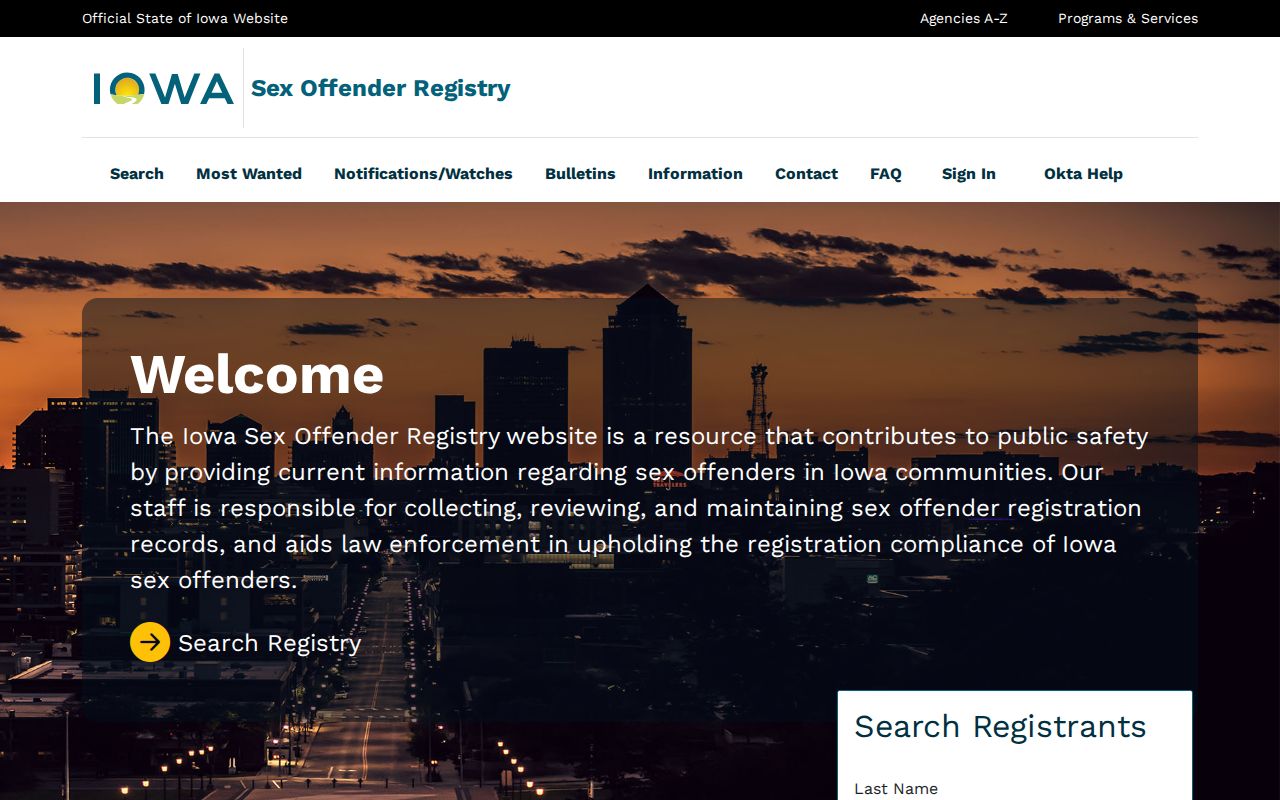
The screen keeps the first search simple, while advanced and map options remain available for a more exact Franklin County check.
Franklin County Registry Watches
An Iowa registry account can watch an address, city, county, ZIP code, named registrant, or group. The system says notices go out within 60 minutes after registered information changes. The site itself updates daily and may refresh as often as every 30 minutes on business days, excluding holidays. Watches are the state’s practical community-notification tool because Iowa does not require an individual notice to every neighbor.
Accounts moved from Enterprise A&A to Okta, so a person with older credentials may need to create or link an Okta account. A Franklin County watch is not the same as a live police alert. It reports changes in registered information. An immediate threat or suspected crime should go to law enforcement, not to an account setting or a registry search form.
Registry Profiles: What They Show
A public profile can combine identity, address, physical, offense, and status information. Read dates and labels together. A photograph may aid identification, but it does not replace the name, aliases, physical descriptors, and registrant identifiers. Address entries may include effective dates. Offense and conviction details should be read as the official profile presents them, without turning the tier into a personal prediction.
| Name and Aliases | Public identity names and known aliases used to distinguish records. |
|---|---|
| Photo and Description | Photograph, gender, age, height, weight, and available skin markings. |
| Registered Address | Public address information and related dates allowed under Iowa law. |
| Offense Details | Conviction and offense information reported for the registration duty. |
| Tier | Iowa offense classification that controls verification and duration duties. |
| Status | Compliance information and a most-wanted flag when noncompliance and an active warrant coincide. |
Public fields are limited by Iowa Code section 692A.121. A missing name can mean the person completed the duty, is outside Iowa, is incarcerated, received a modification, or does not meet public-display rules. It is not proof that no registration record exists.
Franklin County Public Registry Limits
The registry’s county statistics interface provides context without turning a Franklin County search into a list copied by a private publisher.
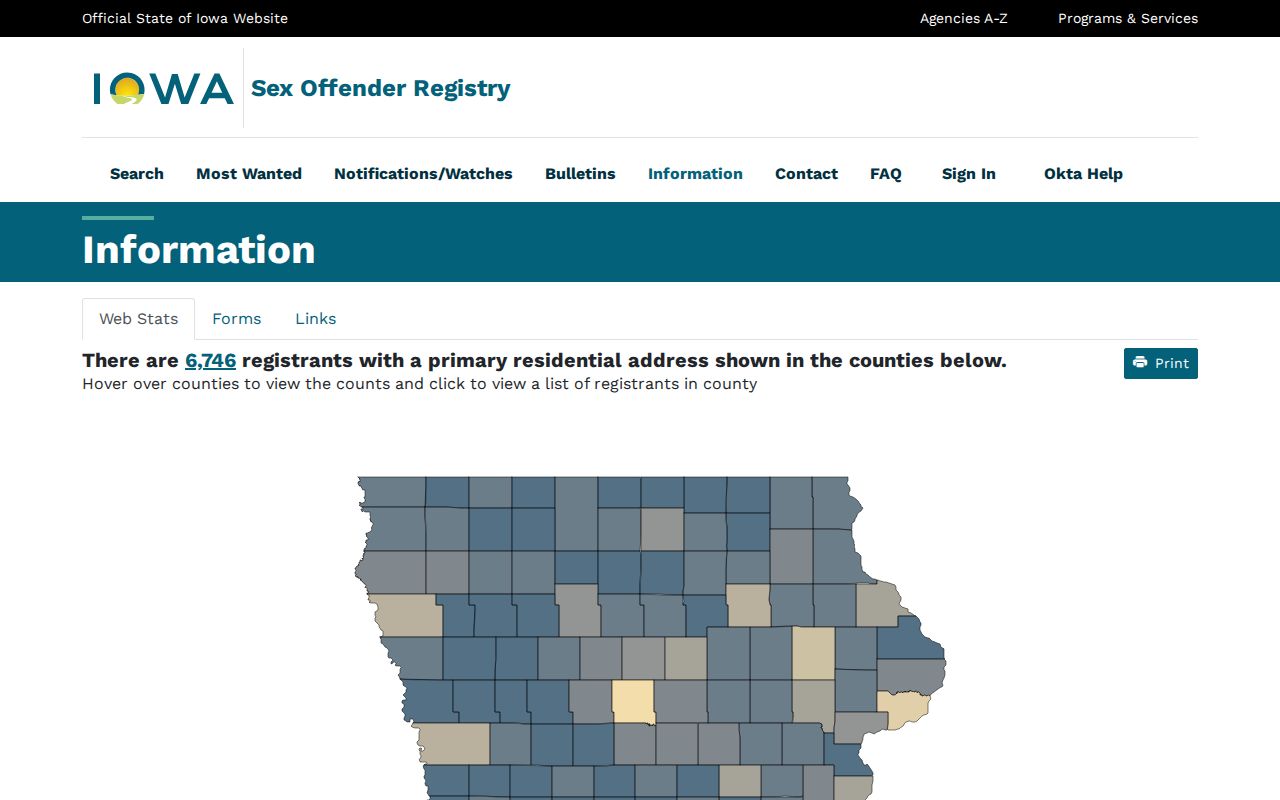
Its county filter can frame local totals, but the public site still does not represent the entire registered population.
When a profile seems wrong, compare the spelling, alias, address date, and status first. Then use the registry contact route or Franklin County Sheriff. Do not confront the person. DCI and the registering sheriff are positioned to check the underlying file, while the public cannot repair a record through repeated searches.
A public omission has several possible causes. The Iowa registry says a person may have completed the required term, received a court-approved modification, moved outside Iowa, died, had the conviction reversed, or be incarcerated. A juvenile matter may also follow rules that keep it from the same public view. These are very different explanations, and a blank Franklin County result cannot choose among them. When identity or safety facts matter, record the search terms and date, check aliases and nearby geography, then ask the sheriff or registry contact for the lawful next step. That method preserves the limits of the public tool while giving officials enough detail to review a possible error.
Registration Levels and Duties in Iowa
Iowa classifies registrants by the qualifying offense. Tier is not a casual label for perceived danger. Iowa Code sections 692A.102, 692A.106, and 692A.108 determine classification, baseline duration, and verification frequency. Tolling, another jurisdiction’s duty, and statutory exceptions can affect an individual case, so the current law and official profile must control.
| Tier | Baseline Duration | Verification |
|---|---|---|
| I | 10 years | Annually |
| II | Life | Every six months |
| III | Life | Every three months |
The official chapter 692A index puts the Iowa registry duties and public-access provisions in one source.
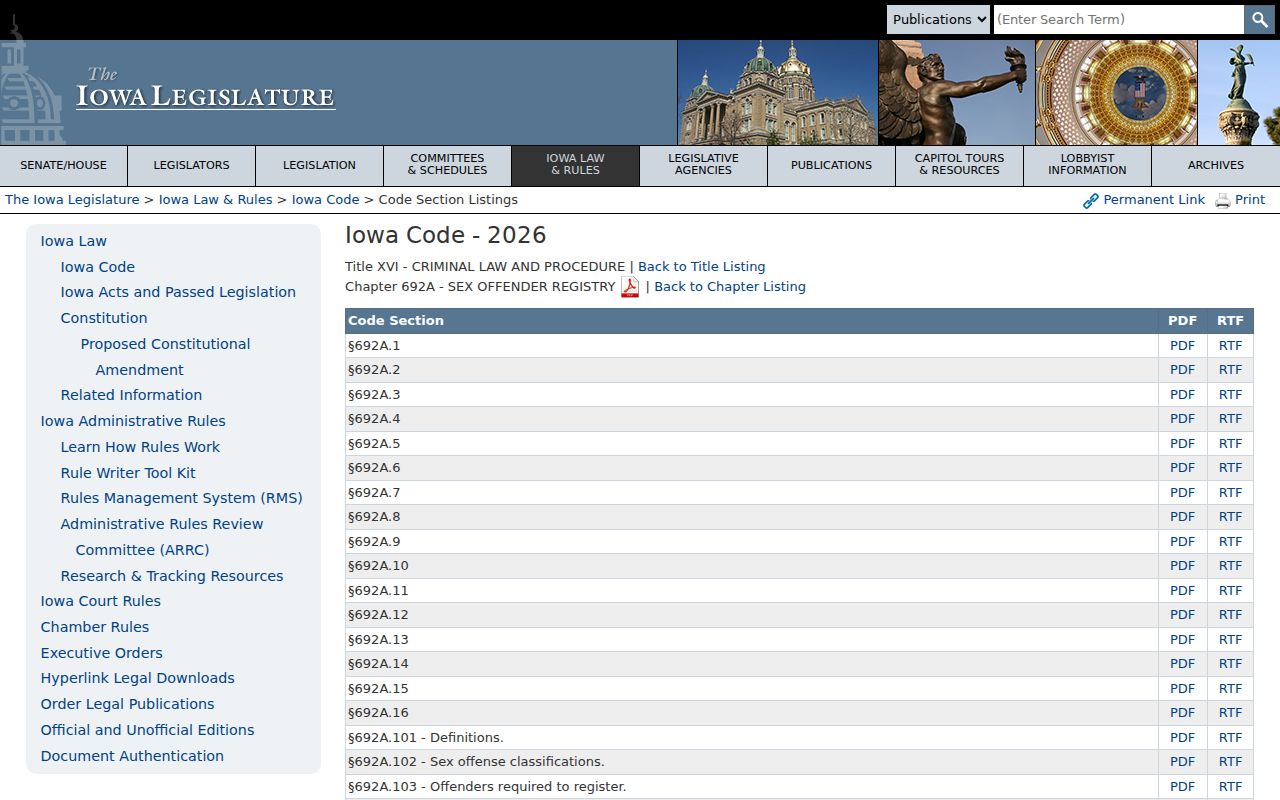
That statute is the right place to verify a current duty instead of relying on a short profile summary.
Franklin County Residence Rule Limits
Iowa’s 2,000-foot residence rule is not universal. Section 692A.114 applies to a person with an aggravated offense against a minor and includes statutory exceptions. It should not be stated as though every Franklin County registrant is barred from living near every school or child-care site. The offense, legal classification, location, and exception language all matter.
Expungement also does not automatically end registration. A court record may be made confidential under a separate law while chapter 692A duties remain. Modification under section 692A.128 requires a court process and conditions that include a minimum registered period, treatment completion, an approved low-risk assessment, notice, and freedom from incarceration. It is not deletion triggered by a routine record update.
Franklin County and NSOPW
The Iowa search is best for Iowa-specific fields, watches, and local registration status. NSOPW is the better second layer when someone may have lived or registered elsewhere. It searches participating state, territorial, and tribal public registries, then routes a reader to the source jurisdiction’s profile. The two tools should be compared, not treated as duplicates.
The U.S. Department of Justice NSOPW search shows the cross-state layer available after an Iowa or Franklin County lookup.
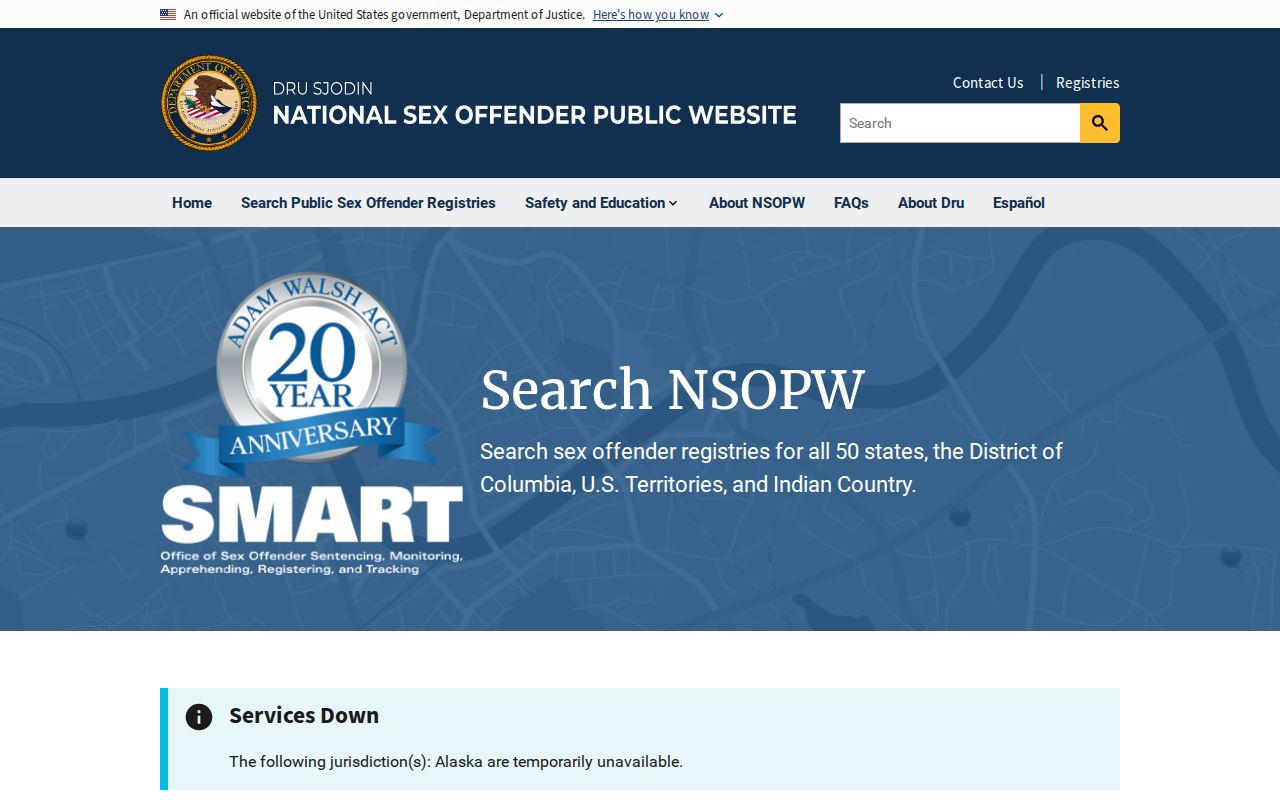
Its value is broader geography, while Iowa DCI and the Franklin County Sheriff remain the sources for Iowa registration details.
Using Registry Information Lawfully
Registry information supports awareness and safety planning. “Most Wanted” has a narrow meaning on Iowa’s system: the person is noncompliant and has an active warrant. It is not an invitation to locate or detain anyone. Report suspected noncompliance through local law enforcement or the registry tip route. Call police at once for an immediate safety issue.
The official noncompliance interface explains the wanted filter without requiring a searcher to focus on a private individual.
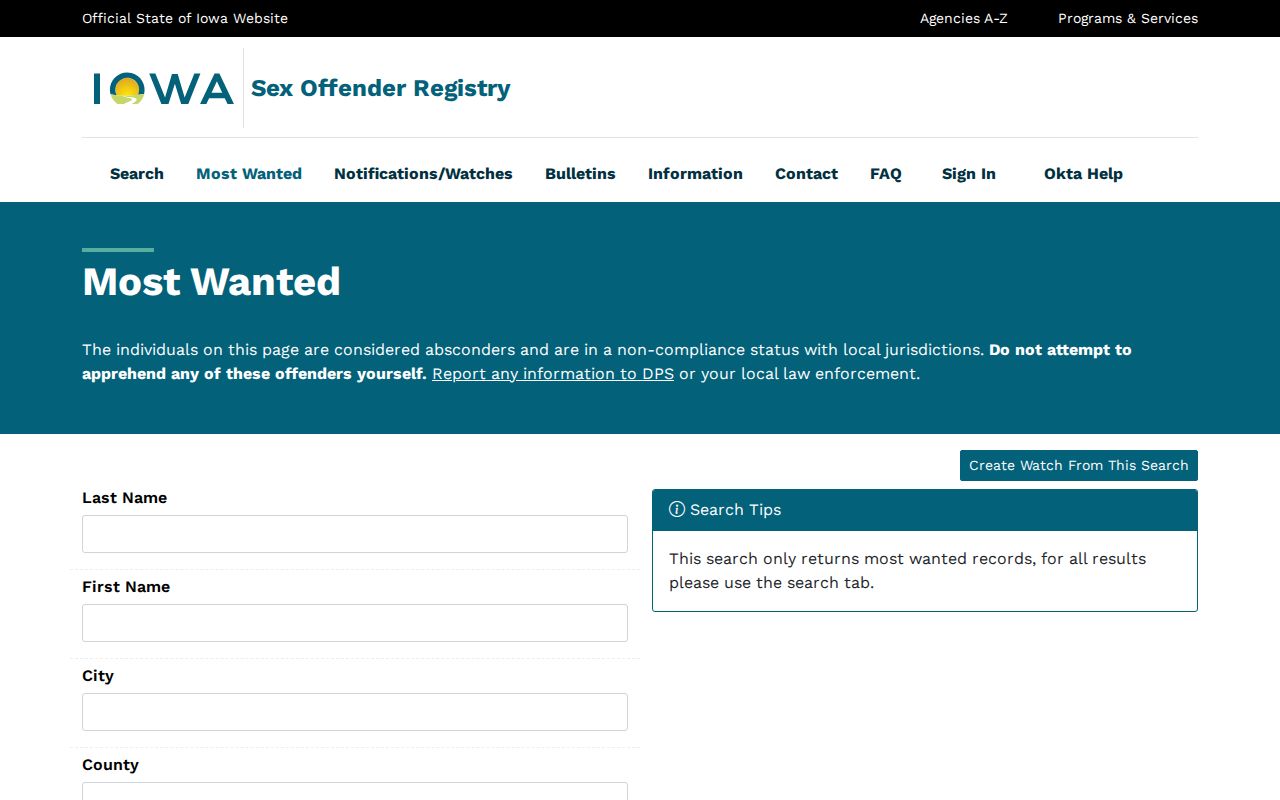
The interface belongs in a law-enforcement process; members of the public should never attempt apprehension.
Use is restricted: Iowa’s registry notice warns that vandalism, threats, stalking, harassment, or assault based on data governed by Iowa Code chapter 692A can lead to arrest and prosecution.
Discrimination or pressure based on a public result can also cause grave harm. Confirm identity and context with the office that maintains the record. A Franklin County sex offender lookup is one safety resource, not a substitute for a current police report, court file, or direct response from the sheriff.