
Franklin County Criminal History Checks
Start with the kind of answer needed. Iowa Courts Online is the first stop for a filed Franklin County case. The Franklin County Clerk of District Court supplies older files, public documents at the courthouse terminal, and copies from the local case file. The Franklin County Sheriff handles sheriff reports, current prisoner routing, and warrant questions. Iowa DCI provides the state criminal-history product. Each channel answers a different question, so a blank result in one does not settle the search.
Good identifiers reduce false matches. Confirm the full name and spelling variants. DCI also requires an exact date of birth, while a known court Case ID or agency case number can take a Franklin County record request straight to the correct file. For a recent event, note the date, place, and arresting agency.
- Search Iowa Courts Online for filed cases, using Franklin County as the county filter when a local result is wanted.
- Open the blue Case ID and review the public charge, docket, disposition, and financial entries.
- Call the Franklin County clerk for pre-1998 files, documents that need courthouse-terminal access, or a public item that is not indexed.
- Call the sheriff for recent custody, sheriff reports, or warrant routing, especially before a new case appears online.
- Order a DCI check when an official Iowa fingerprint-supported criminal-history response is the needed product.
The official Franklin County website shows the county department routes used in this process.
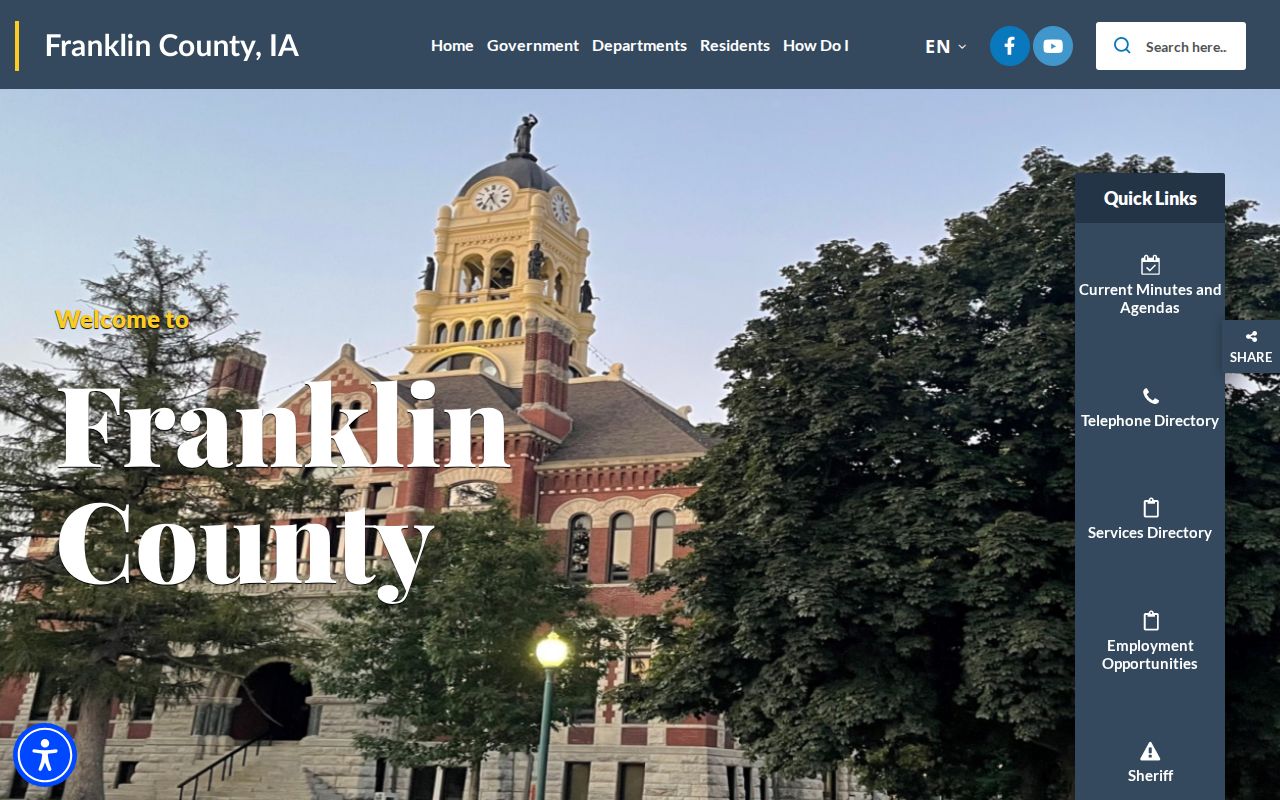
That directory helps separate court, sheriff, and county administration contacts before a request is sent.
Franklin County Records: Two Counters
Franklin County criminal records are split between two main buildings in Hampton. The second-floor Clerk of District Court at 12 1st Avenue NW, Suite 203, keeps filed trial-court records. The clerk can be reached at 641-456-5626 from 8:00 a.m. to 4:30 p.m. on weekdays, with a noon-to-1:00 p.m. closure. The county attorney is in the courthouse basement, but that office prosecutes charges and is not the custodian for police reports or clerk files.
The Franklin County Law Enforcement Center at 105 5th Street SW is the starting point for sheriff incident reports, warrant questions, sex-offender registration, and prisoner location. Its administrative line is 641-456-6035, and its 24-hour non-emergency line is 641-456-2731. Administrative hours are weekdays from 8:00 a.m. to 4:00 p.m. A request may also go by fax to 641-456-2216 or by mail to PO Box 57, Hampton, IA 50441.
The county's official telephone directory sets out the courthouse and Law Enforcement Center offices.
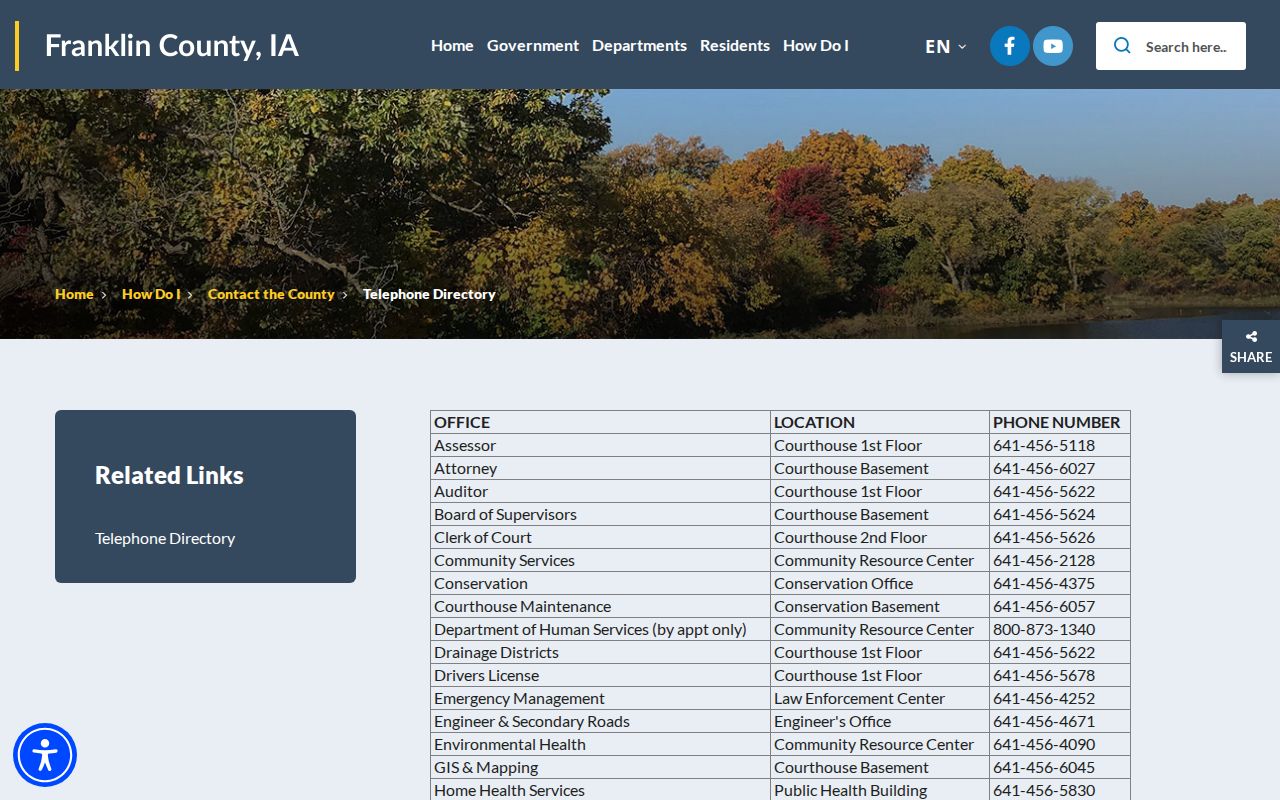
The directory makes a key local point clear: filed cases go to the courthouse, while sheriff and custody questions begin at the Law Enforcement Center.
Official Background Checks in Iowa
The Iowa Department of Public Safety, Division of Criminal Investigation, Records and Identification Unit is the central state repository. Its Iowa Record Check Online information describes online, mail, fax, email, and in-person requests. Phone orders are not accepted. A request needs the subject's first and last name plus exact date of birth. Middle name, gender, and Social Security number are optional matching aids.
The fee is $15 per last name, so another surname requires another request and fee. Both request and billing details are required. DCI lists cash, check, money order, major listed cards, and account billing where applicable. Online and written channels commonly take a few business days depending on staffing and volume. Immediate counter results are limited to a person reviewing their own record with government photo identification.
| Official product | Core requirement | Cost or access |
|---|---|---|
| Iowa DCI name check | First name, last name, exact birth date | $15 per last name |
| Own DCI record at counter | Subject appears with government photo ID | Immediate result may be available |
| FBI Identity History Summary | Subject request plus fingerprints | FBI fee and fingerprint process |
The DCI record-check page shows the official ordering choices used for a Franklin County criminal-history check.
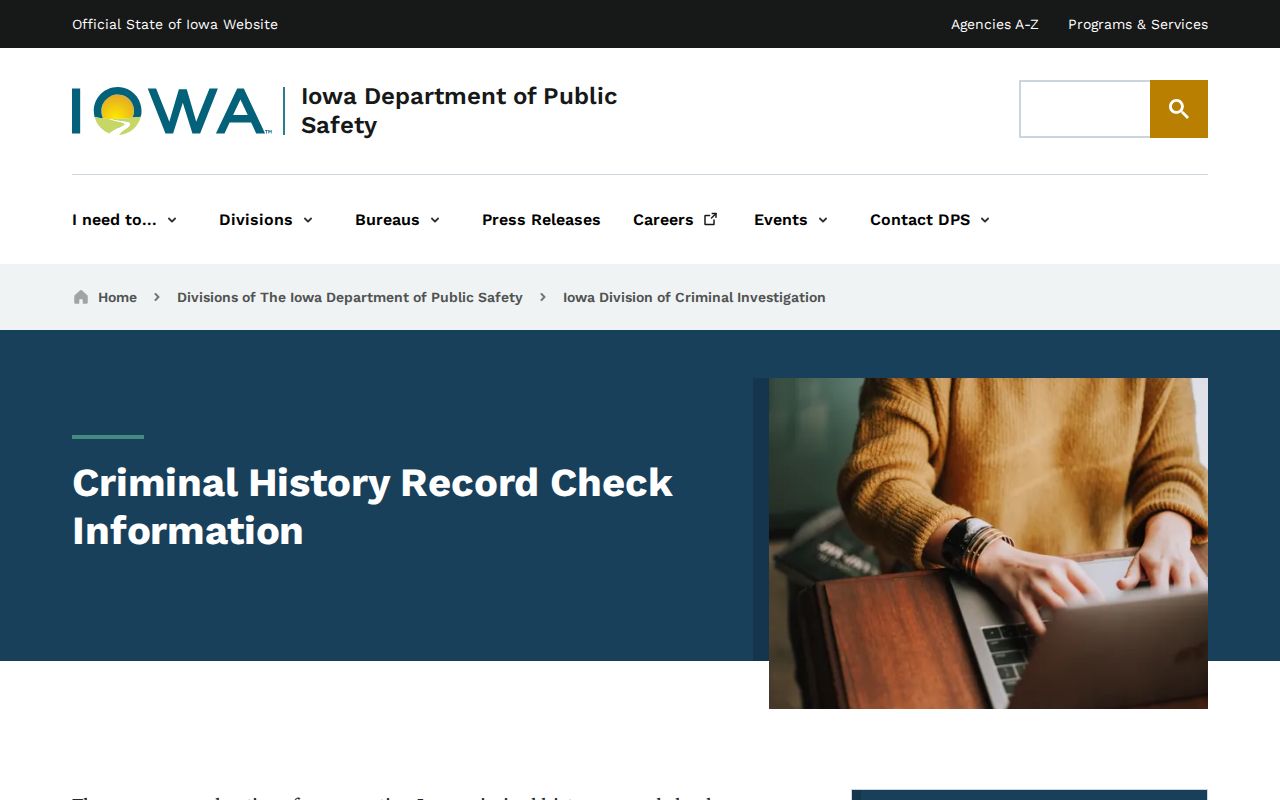
This state product is Iowa-only and should not be mistaken for a county docket search or a nationwide identity summary.
Franklin County Court Records Online
Iowa Courts Online provides free basic docket access for public trial cases generally filed after 1998. Select Trial Court Case Search, then search statewide or narrow the county field to Franklin. A result can show the Case ID, case title, parties and lawyers, charges, docket entries, disposition, fines, fees, and payments. The blue Case ID opens the detail view. A case normally appears one business day after it is added, and existing data then updates in real time.
Free bracketed links and paid features are not the same. Advanced access can add schedules, judgment and lien indexes, exhibits, bonds, service returns, and more complete financial or traffic information. Electronic trial documents can also be viewed at the public terminal in the Franklin County courthouse. Older files and public records that are not electronically indexed require a clerk request.
| Search field | Use | Franklin County tip |
|---|---|---|
| Case ID | Most precise known-case search | Open the matching blue Case ID |
| County | Limits a statewide search | Select Franklin for local filings |
| Last or business name | Party-name search | Add first name to narrow matches |
| Case type | Filters the docket category | Choose the relevant criminal or traffic type |
| Date range | Narrows filing periods | Useful with common names |
Note: Documents delivered to the clerk can take several days to index even when the filing itself remains timely.
Kinds of Criminal Records
A Franklin County criminal-history search may involve several files. The arresting agency writes the incident or arrest report. A host jail creates intake and custody data. The clerk opens a court case after a complaint or trial information is filed. DCI builds a fingerprint-supported state history when prints are submitted. Iowa DOC maintains sentenced custody and public supervision information.
These records can carry different charge wording because each captures a different stage. A police allegation may change when the Franklin County Attorney files a charge, and the court disposition may later show a dismissal, plea, verdict, or sentence.
- Incident or arrest report: the originating agency's account of the event and alleged offense.
- Booking record: host-facility intake, custody, bond, transfer, and release information.
- Court case file: filed charges, docket acts, rulings, disposition, sentence, and financial entries.
- DCI criminal history: fingerprint-linked Iowa arrest cycles and reported dispositions that may lawfully be released.
- Warrant, DOC, and registry records: separate official sources for court process, corrections status, or chapter 692A registration.
Iowa District Court handles Franklin County felonies and misdemeanors through the unified state court. Felonies run from Class A through Class D, while misdemeanors may be aggravated, serious, or simple. The filed classification can differ from the arresting officer's first description. The Iowa Sex Offender Registry is another distinct source: it supports name and place searches and public watches, but does not display the entire registered population.
Franklin County Custody Starts by Phone
Franklin County does not publish a county booking roster and does not operate a conventional local jail for the public to search. The sheriff states that Franklin County prisoners are generally housed in Hardin, Butler, Wright, or Cerro Gordo County facilities. Call 641-456-2731 first to learn which host holds the person, then call that jail for current bond, release, visitation, mail, deposit, and other facility rules.
This is a routing task, not a failed database search. The arresting agency still owns its incident report, the host facility owns its intake information, and the Franklin County clerk owns a filed local case. The official Franklin County Sheriff page identifies the Law Enforcement Center contacts.
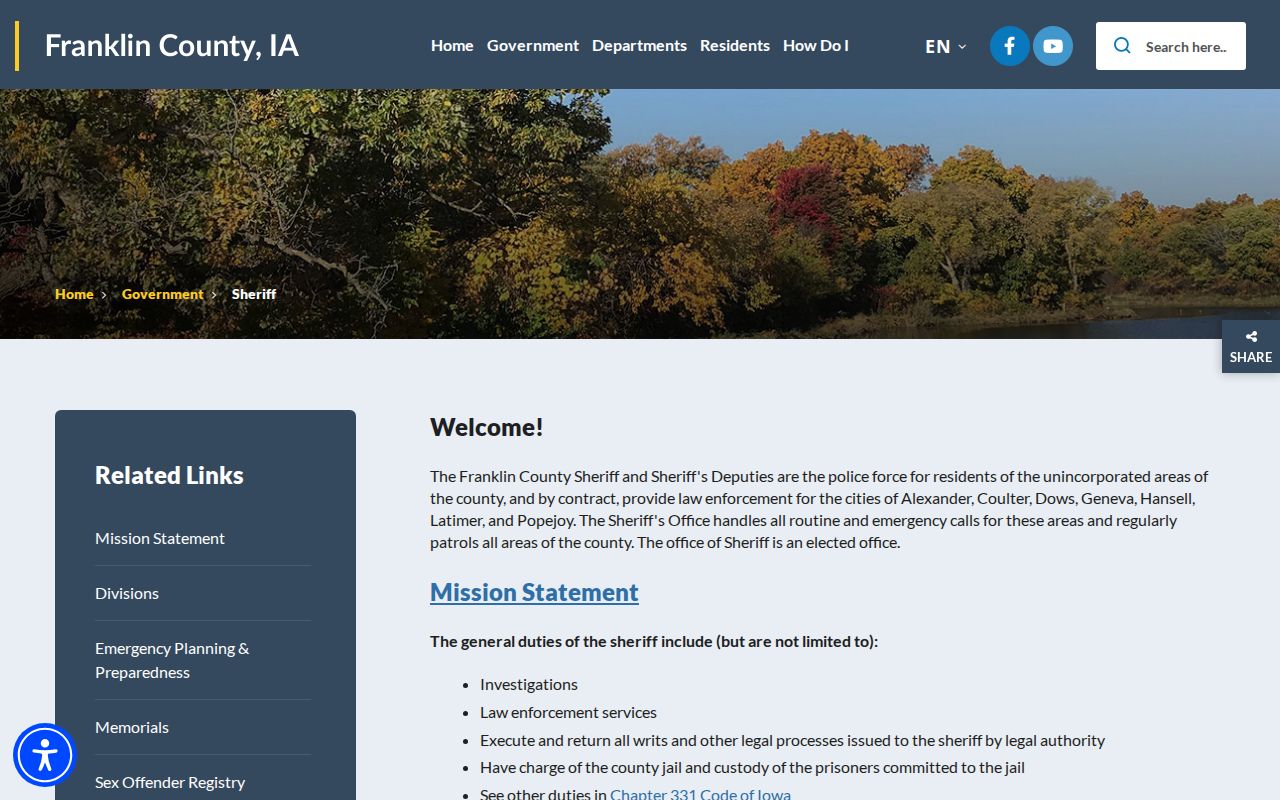
That phone route matters most before a recent arrest has produced a public court entry.
Franklin County Criminal Records: What They Contain
The contents depend on the source. A DCI result can carry identity descriptors, fingerprint-supported arrest cycles, arresting agency and date, arrest charge, a disposition received from court, and sentence information. Iowa Courts Online instead focuses on the filed case. A jail entry deals with present custody. None should be treated as a complete substitute for the others.
| Name & Identifiers | Name and available identity descriptors used to match the correct record. |
|---|---|
| Arrest / Booking Data | Agency, date, asserted charge, intake, host facility, bond, transfer, or release data where public. |
| Charges & Statutes | Initial arrest wording or the separate charge filed in Iowa District Court. |
| Disposition | The court outcome, such as dismissal, plea, verdict, or another final entry. |
| Sentence | Public sentence terms, financial obligations, and related court entries. |
| Custody / Supervision Status | Current host-jail location or Iowa DOC prison and community-supervision information. |
A “No Iowa Criminal History Found” response can mean no DCI file exists, no information is legally releasable, or the only information is confidential juvenile material. Missing fingerprints can also prevent a Franklin County arrest from creating a state-history cycle.
DCI Versus Franklin County Court Records
A $15 DCI response is not a copy of a Franklin County docket. It searches the Iowa central repository and applies chapter 692 disclosure rules. Without a signed release, DCI withholds completed deferred judgments and arrests more than 18 months old when no final disposition is recorded. A signed release can expand what DCI may disclose, but it does not turn the search into a national check.
The court file answers a different set of questions. It can show the filed charge, hearing and docket activity, disposition, sentence, and payments. The sheriff or host jail is better for present custody. Comparing the three can expose a timing gap, an unmatched identity, or a disposition that has not reached DCI.
For a subject's own nationwide identity history, the FBI Electronic Departmental Order portal is the official fingerprint-based route.
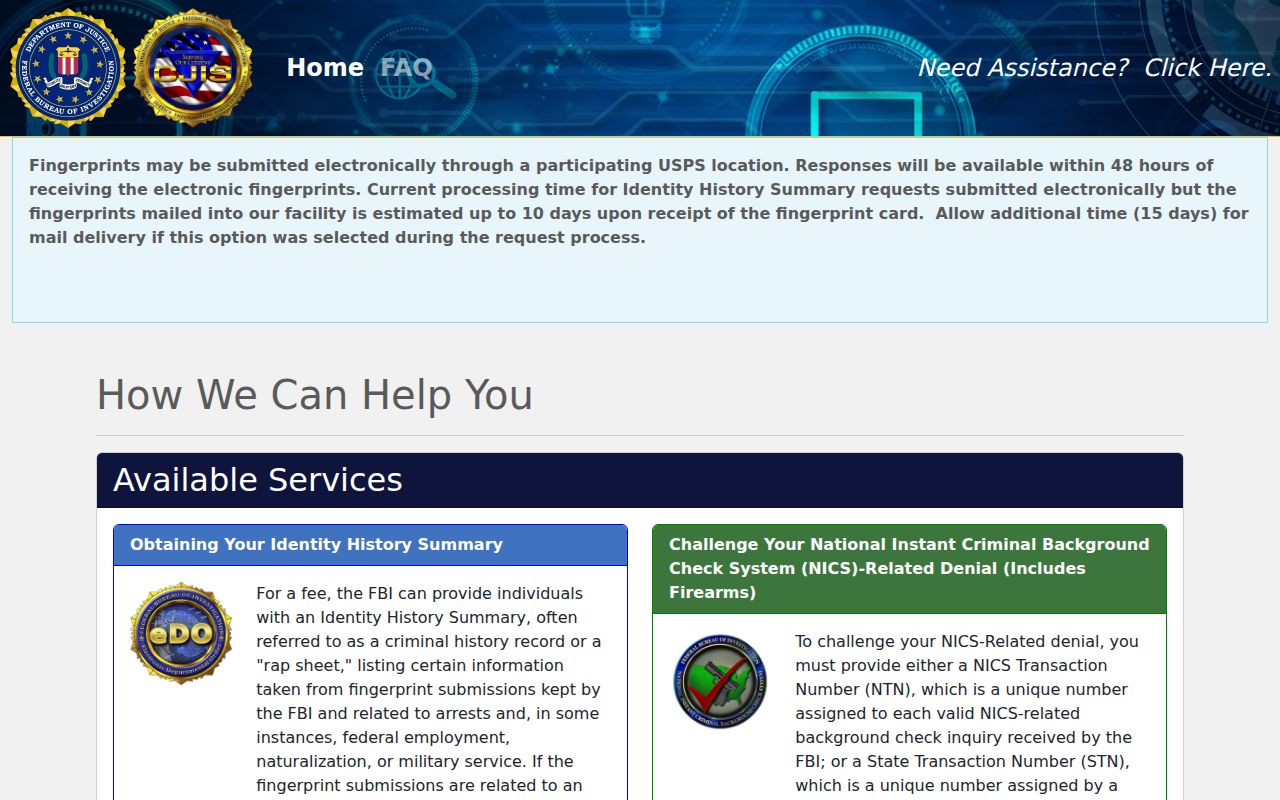
The FBI product reaches beyond Iowa, while Franklin County records remain with the local and state custodians that created them.
Iowa Public Access Laws
Iowa law begins with the record's custodian. Chapter 22 supports inspection and copies of public records, but section 22.7 and other laws protect confidential material. Chapter 692 controls criminal-history data and explains why a DCI response may differ based on consent and the age or disposition of an arrest. Public docket access also does not guarantee that every underlying court document is free on the internet.
Key Statutes:
Iowa Code chapter 22 gives public-record inspection and copy rights, subject to lawful confidentiality limits.
Iowa Code chapter 692 defines criminal-history data and governs its dissemination.
Iowa Code chapter 901C sets the main Iowa expungement routes for eligible cases and convictions.
Iowa Code chapter 692A governs sex-offender registration and public registry access.
Most juvenile court information remains confidential. Active investigations, victim-sensitive details, medical information, protected identifiers, and security material may also be withheld or redacted. A focused Franklin County request should state the event date, place, agency, case number if known, precise record type, and preferred format.
Franklin County Criminal Record Terms
Words that look similar can point to distinct Franklin County records. Reading the label before drawing a conclusion is vital, especially when an arrest charge and the later filed charge do not match.
- Arrest
- A restraint based on an accusation or warrant. It is not proof of guilt.
- Booking
- The host facility's intake process and custody record after an arrest.
- Disposition
- The court's recorded outcome for a charge or case.
- Deferred judgment
- An Iowa court outcome that may be discharged without a conviction but can remain in DCI data under special release rules.
- Probation
- Court-ordered community supervision delivered through Iowa DOC district services.
Current custody, a filed case, and a criminal-history response are three different answers. Use the record date and custodian to understand which answer is on screen.
Restricted, Sealed & Expunged Records
Iowa Code chapter 901C supplies limited expungement paths. Section 901C.2 addresses qualifying dismissed charges and not-guilty verdicts. Section 901C.3 permits one lifetime application for qualifying misdemeanor convictions when the stated waiting period and other conditions are met. Pending charges, unpaid financial duties, and excluded offense categories can bar relief. The filing belongs in the county where the case arose.
Expungement is not a general erasure remedy for every conviction. A qualifying section 901C.3 record becomes confidential, and clerk notice can lead to its removal from DPS criminal-history files if maintained there. Yet completed deferred judgments have their own DCI treatment, and sex-offender registration can continue after a conviction is expunged. Registry modification under chapter 692A is a separate court process.
The current Iowa expungement chapter contains the controlling eligibility terms. The Franklin County clerk can identify the proper form for a case filed in the county.
Note: Ask the Franklin County clerk for the current form and filing cost because a local criminal-case fee was not confirmed in the research.
Franklin County Warrants Without a Portal
No official Franklin County active-warrant search was located. Iowa Courts Online should not be treated as a complete live warrant list. Call the Franklin County Sheriff at 641-456-2731, check with the issuing court or clerk at 641-456-5626, and contact the specific city agency when it may hold the event record. A chapter 22 request may reach releasable warrant information, but sealed, juvenile, or operationally sensitive records can remain unavailable.
A bench warrant often concerns failure to appear or comply with a court order. An arrest warrant rests on probable cause, while a search warrant authorizes a search. Resolution should follow the issuing court's directions and qualified legal advice when needed. Paying unrelated court debt does not itself cancel a warrant. Confirm the Case ID, issuing authority, bond or order, and the steps for surrender or compliance.
Franklin County Supervision and Prison Records
Franklin County is served by Iowa DOC's Second Judicial District. Its work includes probation, parole, pretrial release services, presentence investigations, residential placement, intensive supervision, drug treatment court, sex-offender treatment, and electronic monitoring. The Iowa Board of Parole makes release decisions, while Iowa DOC district staff provide community supervision.
There is no general public Franklin County probation roster. The Iowa Offender Search can show public sentenced custody or supervision information. A Franklin County court docket may show a probation sentence or revocation filing, and a DOC chapter 22 request can seek other public correctional information under Iowa Code section 904.602. IowaVINE is the county-endorsed route for custody status notifications after the first location call.
Note: A probation violation allegation may create a filing or warrant, but it is not by itself a new conviction.
Federal Records Beyond Franklin County
Federal cases do not appear in Iowa Courts Online. Franklin County federal criminal dockets are handled through the proper United States District Court and the official PACER system. PACER requires an account and applies its current per-page fee policy. Federal prison custody belongs in the Bureau of Prisons locator, not Iowa Offender Search. An FBI Identity History Summary is subject-only and fingerprint based.
The official PACER entry page is the starting point for federal docket access.
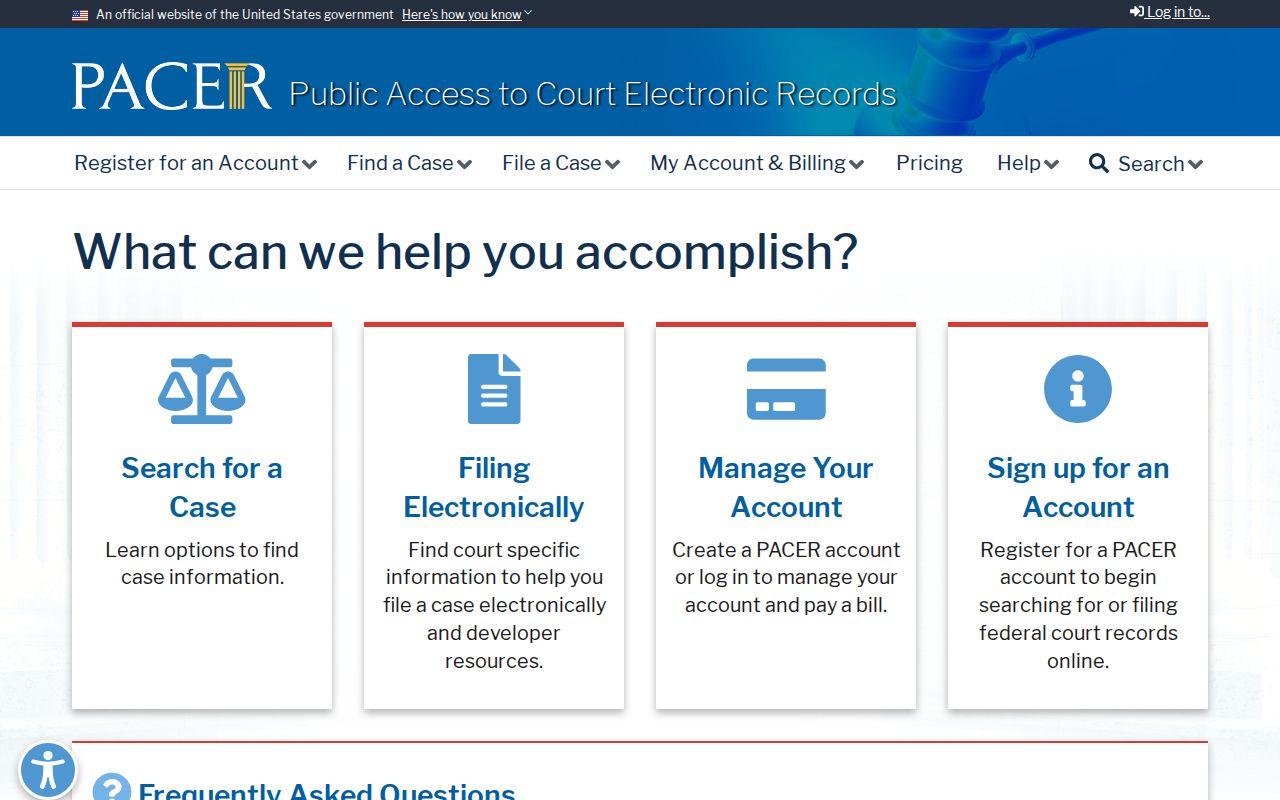
This federal layer should stay separate from Franklin County clerk files, DCI checks, and local custody calls.
Franklin County Justice Records Since 1855
Franklin County was created in 1851 but was not organized until 1855 because the population was too small to hold an election. Before organization, it was attached to Hardin and Chickasaw Counties for judicial and civil purposes. That early regional arrangement echoes the present jail model, in which Franklin County again relies on facilities outside its borders.
The county's official history account traces that start and the county's name honoring Benjamin Franklin.
The practical lesson is current: a Franklin County criminal-record search may need a local counter, a state portal, and an out-of-county host facility.
The official elected-officials directory provides the current sheriff and county attorney listings used for the local justice system.
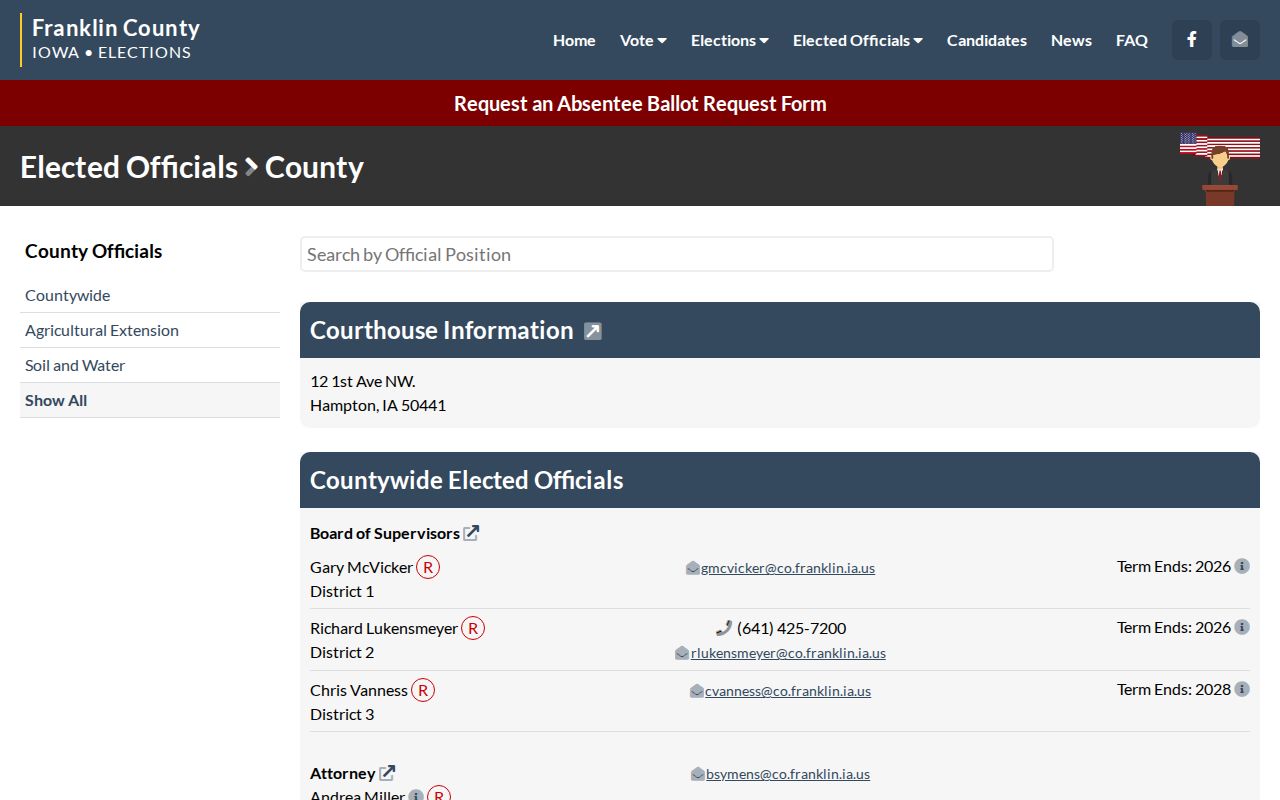
Current office listings matter because staff and elected terms can change while older agency pages remain online.
City-by-City Criminal Records in Franklin County
City-level routes depend on the agency. Hampton has its own police department and no online arrest blotter. Sheffield provides municipal records channels and a police contact, while Dows receives contract policing from the Franklin County Sheriff and crosses the Franklin-Wright county line. None has a separate municipal court. Filed criminal and ordinance cases go through Iowa's unified District Court, but city parking matters remain with the city clerk.
Hampton Record Check
Population 4,337 in the 2020 Census. Hampton Police records begin with the city department, while filed cases go to the Franklin County clerk.
Sheffield Record Check
Population 1,130 in the 2020 Census. Sheffield lists a public-records form and city police contact, with court cases filed countywide.
Dows Record Check
Population 521 in the 2020 Census. Dows crosses two counties, and Franklin County Sheriff supplies its police service by contract.